Shop Safely Online: 5 Ways to Spot a Fraudulent E-commerce Store in India (2026 Guide)
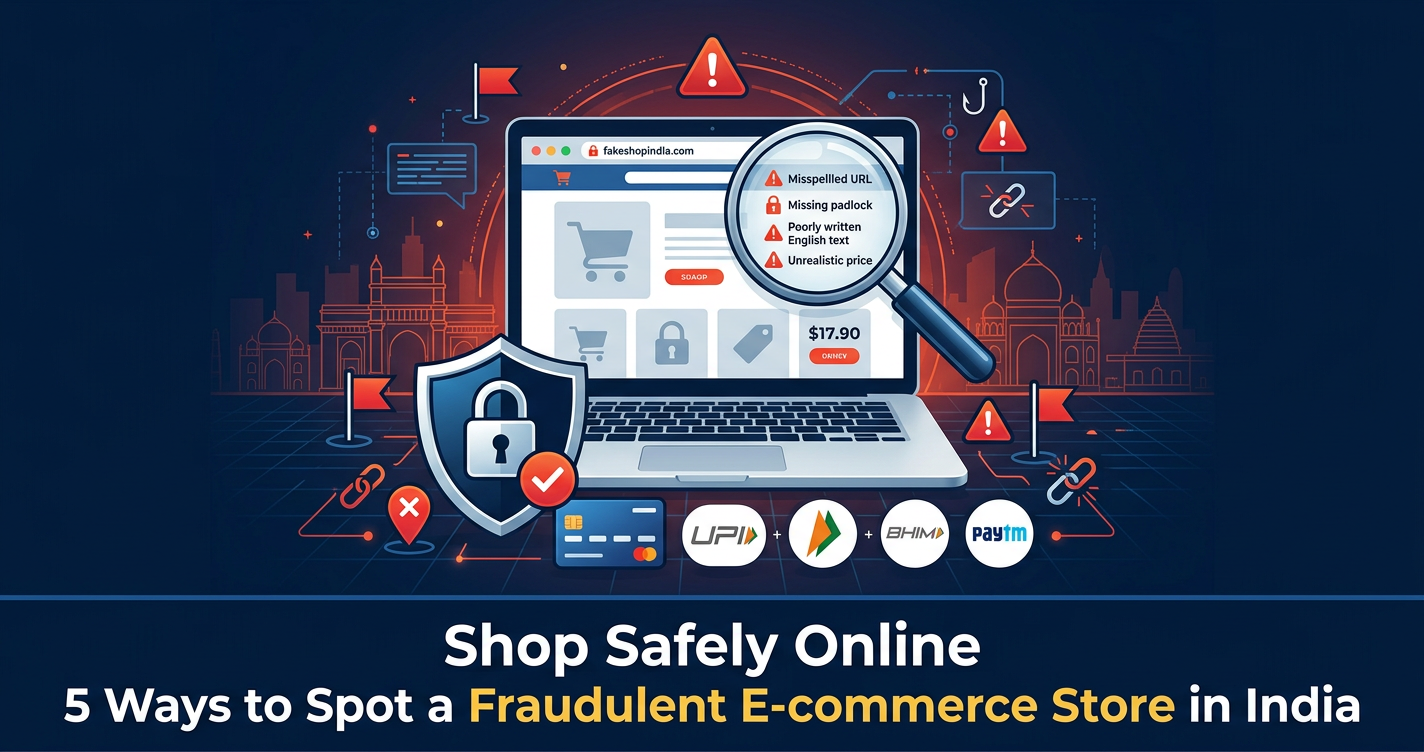
India's online shopping market is one of the fastest-growing in the world. According to a Boston Consulting Group report cited by IBEF, the country's e-commerce industry is projected to grow at a compounded annual rate of 15–17% and reach approximately ₹27.28 lakh crore (around US$300 billion) by 2030. That scale of growth brings genuine opportunity for buyers and sellers alike. It also brings fraudsters.
The numbers on cyber fraud are sobering. A Press Information Bureau release from February 2026, covering a Union Home Ministry conference on the subject, noted that an estimated ₹20,000 crore in cyber fraud had occurred, with authorities managing to freeze or return ₹8,189 crore to victims. As of November 30, 2025, more than 8.2 million cybercrime complaints had been registered on the I4C reporting portal, with 184,000 converted into FIRs.
A fraudulent e-commerce store isn't always easy to spot at first glance. It might be a near-perfect clone of a well-known brand's website, a one-page discount storefront pushed through Instagram ads, or a seller with no verifiable business presence outside a WhatsApp number. These operations tend to surge during festive sale seasons, when shoppers are already primed to move fast and ask questions later.
This guide covers five specific red flags to check before you pay. Go through it once, save it, and make it a habit before buying from any store you haven't used before.
1. Scrutinize the Website's Design, URL, and Domain
The website itself is the first thing you encounter, and it's also one of the most telling. Fraudulent stores are typically built fast, and that speed leaves visible traces.
What poor design actually signals
Blurry product images, fonts that change between pages, broken navigation links, and copy riddled with grammar errors are all consistent with a site that was not built to last. Legitimate retailers put effort into how their storefronts look because first impressions affect buyer trust. A site that looks assembled from a free template, with product images that are low-resolution or pulled straight from stock libraries without editing, deserves a closer look before you proceed to checkout.
The URL is worth reading carefully
Counterfeit sites mimicking large platforms rely on domain names that pass a quick glance but don't hold up under scrutiny. Common tactics include adding extra words to a brand name (flipkart-offersale.in), swapping characters that look similar (arnazon.com instead of amazon.com), or using domain extensions that don't match the brand's actual presence. Always type a store's address directly into your browser rather than following links from SMS messages, WhatsApp forwards, or promotional emails.
The padlock icon is not a trust certificate
This is a widely misunderstood point. The HTTPS indicator and padlock icon in your browser bar confirm only that data between your browser and the server is encrypted in transit. They say nothing about who owns that server or whether the business behind it is real. Fraudulent sites can obtain valid SSL certificates without difficulty. Do not use HTTPS alone as a reason to trust a site.
2. Verify Contact Details, Business Information, and Domain Ownership
A legitimate business operating in India is traceable. If you cannot find a working phone number, a real physical address, or any company registration details on a store's website, that absence is meaningful.
What to look for on a trustworthy seller's site
Check the Contact Us and About Us pages for a registered business address, a functional customer support number, and an email address on the same domain as the website, not a Gmail, Yahoo, or Hotmail address. Indian sellers registered under GST will generally display their GSTIN on the website or on invoices. The absence of any of these details, on what claims to be an operating national retailer, is a warning sign worth acting on.
Run a WHOIS lookup on the domain
A WHOIS lookup (available through tools like who.is or the NIXI registry for .in domains) shows when a domain was registered, by whom, and often where. A domain registered within the past few weeks, with all registrant details hidden behind a privacy shield and no corresponding business presence elsewhere, warrants real skepticism. The Delhi Police Cyber Crime Unit's advisory on fake shopping sites specifically flags domain registration checks as a step shoppers should take before buying from an unfamiliar store.
Search the store name independently
Run a Google search using the store name alongside terms like "reviews," "complaint," or "scam." Check the Ministry of Corporate Affairs database at mca.gov.in if you want to verify whether a company is actually incorporated in India. Established brands will have a consistent footprint across multiple independent platforms; fraudulent ones typically don't.
3. Watch Out for Extreme Discounts and Manufactured Urgency
Discounts are a standard part of online retail in India. The issue isn't the discount itself; it's a specific pattern that shows up consistently in fraudulent stores: the offer is always slightly implausible, and there's always a reason you need to pay right now.
The discount profile of fake stores
Smartphones listed at 80% off. Branded running shoes at ₹499. Consumer electronics a fraction of their launch price, supposedly due to a clearance that only you seem to have found. These listings are engineered to trigger the part of a buyer's brain that prioritizes not missing a deal over asking whether the deal makes sense.
Genuine retailers do run deep-discount sales, particularly during Diwali, Eid, and end-of-season periods. The difference is context: a real sale is on a brand's verified domain or a known authorized platform, with pricing that is consistent across multiple channels and corroborated by public announcements.
Countdown timers and stock alerts are pressure tools
"Offer ends in 9 minutes." "Only 1 left in stock." These are standard design elements in fraudulent stores, and their purpose is to make you complete the payment before you have a chance to verify anything. If a site is pressuring you to buy within a narrow time window, use that window to check the seller's credentials instead of rushing to the payment page.
4. Check Payment Options and How You're Asked to Pay
The payment experience on a legitimate Indian e-commerce store follows a predictable structure. When something in that structure looks off, it's worth stopping.
No Cash-on-Delivery option is a red flag
COD is standard across Indian online retail because it allows buyers to inspect what they're receiving before handing over money. Fraudulent stores disable it almost without exception, because their business depends on receiving payment before the buyer realizes nothing is coming. A store that accepts only prepaid options and has no verifiable business footprint should be treated with serious caution.
Direct UPI transfers to an individual are not a legitimate checkout process
A genuine e-commerce transaction routes payment through a recognized payment gateway, such as Razorpay, Cashfree, or PayU. These platforms maintain transaction records and provide some mechanism for dispute resolution. If a store asks you to transfer money directly to a personal UPI ID, a phone number, or a wallet account belonging to an individual rather than a business, you are not dealing with a formal retail operation.
No legitimate process asks for your OTP or CVV over a call
This applies to every scenario without exception. No real payment flow requires you to read your OTP, CVV, or full card number aloud to a person calling you. If anyone claiming to be from a store's customer support, or from your bank regarding a pending transaction, asks for any of this, end the call immediately.
5. Investigate Reviews, Ratings, and Social Media Presence
Customer reviews are one of the most useful signals available, but only when they're genuine. A growing share of fraudulent stores include fabricated reviews, and some are sophisticated enough to fool a quick read.
How to assess reviews without being misled
Don't rely exclusively on the reviews displayed on the store's own website or app. Search for the brand on Google Reviews, consumer complaint forums like TrustGate, or the INGRAM portal. Authentic customer feedback tends to be varied in tone, specific about the product and delivery experience, and occasionally negative. A wall of five-star reviews with similar phrasing, no complaints, and user profiles all created within the same month is a pattern worth noting.
ICICI Bank's Orange Book (Vol. 55, December 2025) covers the identification of online shopping scams in India, including guidance on recognizing fabricated seller pages and what to verify before completing a purchase.
What a store's social media presence should look like
Check when the store's accounts were created, how consistently they have posted, and how they respond to negative comments. Established retailers have a visible history across platforms; their engagement is organic, their complaints are acknowledged, and their branding is consistent. A page launched a few months ago with tens of thousands of followers, no genuine conversation in the comments, and no record of resolving customer issues is almost certainly an artificial presence.
Influencer promotions are not a verification method. Some fraudulent operations pay for promotional posts, and content creators do not always vet the businesses they feature. If a sponsored post or affiliate link is driving you toward a deal that seems implausible, verify the store independently rather than treating the endorsement as confirmation.
For reference, well-established Indian online stores, such as LaNoira, maintain verifiable domain histories, consistent branding across platforms, and real customer interactions. That combination is the baseline you should expect from any unfamiliar seller before completing a transaction.
What to Do If You've Already Been Scammed
If you've transferred money to a store you now suspect is fraudulent, time matters. The faster you act, the better your chances of limiting financial loss.
Step 1: Preserve evidence. Screenshot the website URL, the product listing, any order confirmation, and all payment records, including UPI transaction IDs or card statements.
Step 2: Report to the National Cyber Crime Reporting Portal. File a complaint at cybercrime.gov.in or call the national helpline 1930. This is the government's official infrastructure for registering cyber fraud in India. Early reporting improves the chance that funds can be identified and frozen before they're moved.
Step 3: Report phishing messages. If the scam originated from a fraudulent SMS or call, report it through the Sanchar Saathi portal at sancharsaathi.gov.in.
Step 4: Contact your bank. Most Indian banks have dedicated fraud helplines. If you paid by card, request a chargeback. If you paid via UPI, report the transaction to your bank and through the NPCI dispute resolution process. File a complaint at the nearest police station as well; an FIR strengthens the recovery case.
Quick Recap: Pre-Checkout Checklist
Before paying on any unfamiliar store, run through these five checks:
- Design and URL — Does the domain match the brand exactly? Is the site consistent and properly maintained?
- Business information — Is there a verifiable address, customer support number, GSTIN, and company registration?
- Pricing and urgency — Is the discount realistic? Is there time pressure pushing you to pay before you've verified anything?
- Payment options — Is COD available? Does the payment route through a recognized gateway rather than a personal account?
- Reviews and social presence — Are there genuine independent reviews? Does the brand's social media history look real and consistent over time?
Conclusion
Most online shopping fraud in India follows patterns that are recognizable once you know what to look for. The stores that target buyers aren't particularly sophisticated; they rely on urgency, plausible-looking design, and the assumption that shoppers won't spend a few minutes verifying before paying. That assumption is exactly what makes pre-checkout verification worth building into a habit.
Save this checklist somewhere accessible before the next festive sale season. A quick check against these five points takes under five minutes and is a reliable way to protect both your money and your personal data.
Frequently Asked Questions
How do I know if an online store is fake before paying?
Check the domain name for misspellings, look for verifiable contact details and a GST number, run a WHOIS lookup on the domain, search for independent reviews, and confirm the payment process goes through a recognized gateway. If several things don't add up, don't proceed.
Can I get my money back after an online shopping scam in India?
It depends on how quickly you act and how the payment was made. Card payments have a chargeback process through your bank. UPI transfers are harder to reverse, but reporting to cybercrime.gov.in or calling 1930 promptly gives the best chance of funds being frozen before they're withdrawn. As of November 2025, the government had managed to return ₹8,189 crore out of an estimated ₹20,000 crore in losses across registered cases.
Is COD always safer than prepaid?
For purchases from unfamiliar sellers, COD significantly reduces your financial risk because you can inspect what you receive before paying. That said, COD does not protect against receiving a counterfeit or incorrect product. Buying from established, verifiable sellers remains the safest approach, regardless of payment method.
Is it safe to buy from social media ads?
Not automatically. Social media platforms allow virtually anyone to run paid promotions, and fraudulent stores regularly use Instagram and Facebook ads to drive traffic. If an ad leads you to a store you've never heard of, treat it the same as any unfamiliar site: check the domain, look for verifiable business details, and search for independent reviews before paying.
Which payment method is safest for online shopping in India?
For stores you haven't used before, COD is the lowest-risk option. If COD isn't available, pay through a recognized gateway using a credit card, since credit cards offer the strongest chargeback protection compared to debit cards or UPI. Avoid direct UPI transfers to individual accounts entirely when buying from an unverified seller.
Rohan
Author